
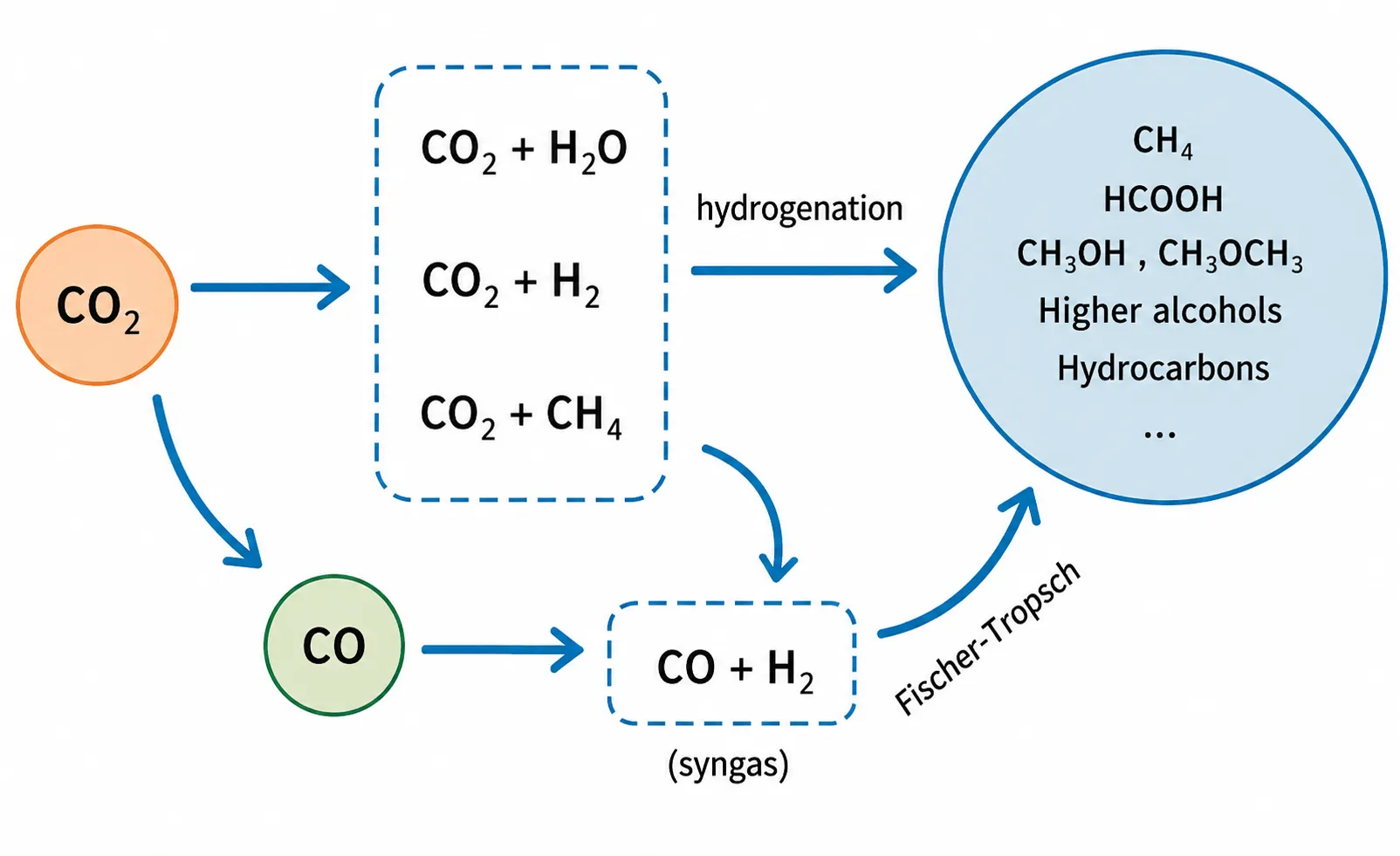
Methanation is a chemical reaction that converts COx to methane through hydrogenation. The process for converting CO2 to CH4 across the ‘Sabatier’ reaction (10.1) was proposed by Paul Sabatier and J.B. Sendersens in 1902. Because of the up-to-date good availability and low enough price of natural gas, units of large-scale methane production on the basis of carbon dioxide have not been widely established, while just a few plants on the basis of carbon monoxide. With the rapid development of renewable electricity, Power-to-Gas technology as an energy-efficient energy storage solution, methanation is being more and more important and gains a lot of attention.
(10.1)CO2+4H2↔CH4+2H2OΔH298=−165kJ/mol
This reaction thermodynamically favored taking place at relatively low temperatures and high pressures. CO to CH4 recaton is described by 10.2:
(10.2)CO+3H2↔CH4+H2OΔH298=−206kJ/mol
that is the reverse process of Steam Reforming reaction. In effect, Equation 10.1 can be seen as the sum of Equation 10.2 with the reverse Water Gas Shift reaction, 10.3.:
(10.3)CO2+H2↔CO+H2OΔH298=41kJ/mol
CO+3H2→CH4+H2O
The Great Plains Gasification Plant in the US producing 160 million cubic feet per day of SNG is the only large-scale commercial coal-based SNG plant out of China, while the SNG projects just have been experiencing a slow start in India, South Korea, etc. [21,22].